
Blogs
Insurance Verification: The First Step to Getting Paid Faster

The healthcare revenue cycle’s success is largely determined before a patient ever sees the physician. Verifying a patient’s insurance coverage is the absolute cornerstone of a medical practice’s financial health. Failing to properly execute this step remains a leading cause of claim denials and administrative waste. When staff simply copy an ID card without confirming…
Read MoreIs Your Practice Losing Revenue Without Realizing It?

Running a successful medical practice requires balancing exceptional patient care with sound business operations. Yet, even the most dedicated providers and clinic managers often face a frustrating reality: working harder, seeing more patients, but watching profit margins shrink. If this sounds familiar, your clinic might be suffering from a silent but devastating problem known as…
Read MoreThe 10 Most Common Reasons Medical Claims Get Denied (And How to Prevent Them)

The financial health of any medical practice relies heavily on a smooth, predictable revenue cycle. Yet, healthcare providers today are facing an escalating crisis: denied medical claims. According to recent 2026 data, the average all-payer claim denial rate has climbed to roughly 12% to 15%, with in-network ACA Marketplace plans seeing denial rates as high…
Read MoreCommon CPT Coding and Billing Mistakes in Ophthalmology
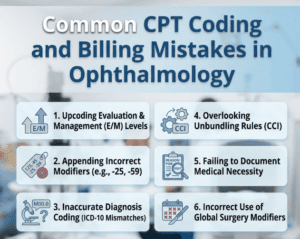
Accurate Current Procedural Terminology coding and medical billing dictate the financial health of an ophthalmology practice. Precision in coding ensures that providers receive appropriate reimbursement for the specialized services they deliver. When ophthalmic coders and billers make errors, the resulting claim denials severely restrict cash flow. Poor billing practices also introduce significant compliance vulnerabilities. Ophthalmology…
Read More15 Medical Billing KPIs Every Ophthalmology Practice Should Track
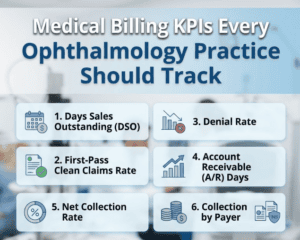
Medical billing key performance indicators are quantifiable metrics that evaluate the financial health and operational efficiency of a healthcare practice. For ophthalmology practices, these metrics transform raw billing data into actionable financial intelligence. Monitoring these data points is not just a bookkeeping exercise. It is a fundamental strategy to improve revenue cycle performance, accelerate cash…
Read MoreThe Complete Guide to Revenue Cycle Management for Ophthalmology Practices

Revenue cycle management in ophthalmology dictates the financial viability of a practice. It encompasses the entire lifecycle of a patient account from the initial appointment scheduling to the final payment collection. Ophthalmology billing is uniquely complex. Practices must constantly navigate the overlapping boundaries between medical insurance and routine vision plans. They must manage high volume…
Read MoreCPT Code for Diabetic Eye Exam 2026

What is a Diabetic Eye Exam? A diabetic eye exam is a comprehensive or intermediate ophthalmologic evaluation performed to detect diabetes-related eye complications such as diabetic retinopathy, macular edema, glaucoma risk, and cataracts. It typically includes: Because diabetes can significantly affect ocular health, regular eye examinations are essential for early detection and prevention of vision…
Read MoreCPT Code for Foreign Body Removal Eye 2026

Foreign body removal from the eye is a common yet highly specialized Ophthalmology procedure that requires precise medical coding for correct billing and reimbursement. Because ocular trauma can involve different eye structures such as the cornea, anterior chamber, or posterior segment, selecting the correct CPT code for foreign body removal eye depends entirely on the…
Read MoreRoutine Eye Exam CPT Code 2026

What Is the Routine Eye Exam CPT Code? Understanding the correct routine eye exam CPT code is essential for optometrists, ophthalmologists, medical billers, and healthcare administrators. Accurate coding ensures proper reimbursement, reduces claim denials, and supports compliance with payer requirements. Routine eye examinations are performed to evaluate visual acuity, assess refractive errors, prescribe corrective lenses,…
Read MoreICD-10 Code for Eye Floaters

Eye floaters are a common visual symptom described as small spots, threads, cobweb-like shapes, or shadows that move across a person’s field of vision. In medical coding, eye floaters are not always assigned a single standalone diagnosis code because they are often documented as a symptom linked to underlying vitreous or retinal conditions. The most…
Read More